

How to build a product launch SEO strategy? [Quick answer]
👉 A product launch SEO strategy can include these four steps, either in full or only some of them: creating new content (landing pages, blog posts, free tools, help docs), using pages that already get traffic (highlight the new feature on existing high-traffic pages, as well as update old posts around the feature), building off-page support (work to get mentions on content that ranks in Google and is cited in AI answers for the topics you need), and localizing this content if you sell in other markets. The scale of your approach should depend on how big the launch is and what the search demand is (how much people already search for what it does).
I often work on SEO for new product launches within go-to-market (GTM) campaigns and organize teamwork around that. So I’ve come up with this 4-layer framework to have a clear structure before planning SEO and AEO initiatives.
In this article, I’ll share my approach on how to organize SEO as a part of GTM campaigns to support a new product launch – especially in B2B SaaS.
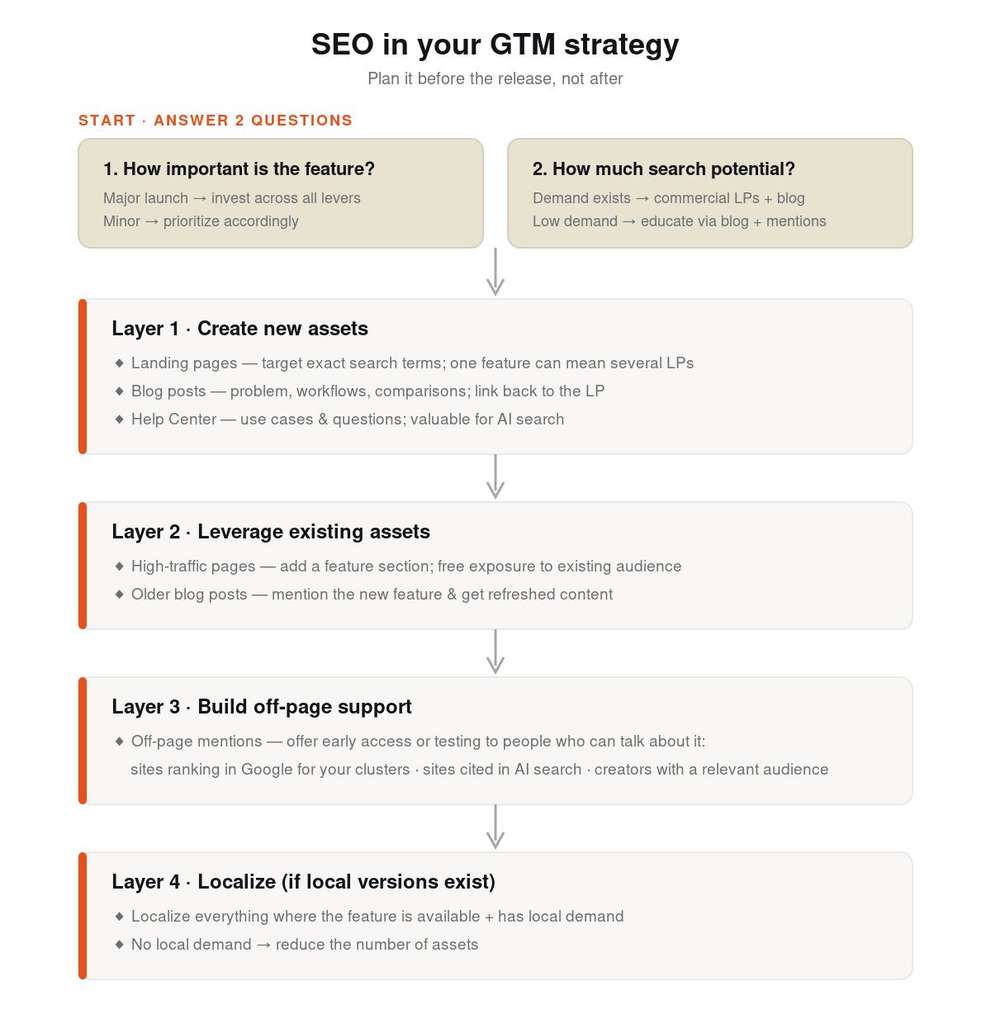
The four-layer product launch SEO strategy at a glance
Here are the main four layers for approaching SEO for new product launches. There’s also a Layer 0 for demand research (keyword and market research) and building a content plan, which isn’t included in this framework to simplify the structure.
| Layer | What you do | When to lean into it |
|---|---|---|
| 1. Create new content | New landing pages for the exact terms people use, supporting blog posts, help center docs, free tools or templates | Major launch, or clear existing search demand you can map to pages |
| 2. Use content that already brings traffic | Add the feature to high-traffic relevant pages, reposition old ranking posts around it | With blog content, do this always – update older relevant blog posts to feature new releases; with top traffic pages, support most important launches |
| 3. Build off-page support | Reach out to sites that rank well in Google and are cited in AI search | Do this for bigger launches that are important for business long-term |
| 4. Localize | Translate and adapt the assets above for markets with real local demand | Only if the feature ships in those markets and demand exists there |
How to decide how big your SEO GTM plan should be
Before I decide how much SEO work a product launch gets, I keep two questions in my head that shape the scope of work.
A brief formula is importance × demand. The bigger both are, the bigger your SEO focus and your expectations from the organic channel should be.
Importance of a new product feature
The first question is how important this new feature is to the business. A major launch, the kind the whole company is organized around, justifies going deep and investing across every layer, while something minor gets a proportional response. Not every feature deserves a landing page and a content cluster or brand mentions built around it. Some features mean organizing the whole website around them, and some features will just get a single blog post and a couple of relevant mentions on related blog posts.
Search demand
The second question is how much search demand already exists, which practically means how big the outcomes (volumes of traffic and leads) you can bring with SEO efforts are.
If people are already searching for what the feature does, build a content cluster around that topic: the landing page targets the main commercial queries, while blog content covers supportive topics for different stages of the user journey.
If search demand is low or doesn’t exist yet, you should build awareness around the product first. A feature no one searches for yet is still worth SEO work, but it requires engineering the demand first, which is a more complicated, longer task and requires collaboration with other teams like social media. In practice, this means creating content that educates the market and getting the feature mentioned on pages people already read. This also means collaboration with other teams.
These two answers give you an understanding of the scope. High importance plus high demand means all four layers are included. Low importance plus low demand might mean one paragraph added to a page that already ranks, plus one blog post about the release or a couple of small articles in the help center. And as with most things, most launches sit somewhere between, with the goal of getting optimal SEO results for optimal effort.
A bonus tip is on approaching new use cases or products with no demand yet and no proper competitors. Over the last year, I also had many cases where we simply didn’t have any search data because the concepts and tasks were new (like promoting an MCP for SEO when it first started). As an SEO, I usually use my intuition and understanding of the market before I have any real search data. Then, my approach is to create a new page or article quickly and start collecting data in GSC to see the real search queries and demand – and to optimize for them after the page is published.
Now, let’s move to each SEO layer.
Layer 1: Create new content
This is the layer everyone thinks of first, and often it’s the right instinct.
Some companies treat blog posts as the only SEO pages they have, and that can work for them. If you have different types of pages, use them. Create a landing page for the feature, a few blog posts for different decision stages and user needs, free tools if they are relevant, and help content that covers the issue.
New landing pages
Landing pages are often the main space for conversion into that feature, and I usually classify them as commercial clusters. A quick rule of thumb that often works for a product release is one page dedicated to one feature. If the feature isn’t live yet, create a proper page with optimized content and add a “coming soon” label.
One feature often needs several pages, because the search intents behind it differ. A tool that does three jobs may need three pages, each matching a different query, rather than one page trying to rank for everything.
Another thing to consider here is that some pages will need an interactive experience and should provide some free value on the page itself. This naturally lowers the conversion rate, but it is often necessary to rank in the top results.
Even when the volume looks small, a dedicated page is usually worth testing, especially since AI now lets you speed up the work and create things faster. Search demand for a genuinely new capability tends to be tiny at first and grow as the category forms. The page you publish now is what captures that demand as it appears.
Remember to create pages that target the exact terms people use when they search for what the feature does. Not what you call the feature internally, but the words buyers actually type. A side note here: it’s often a good idea for SEOs to help name features so they match how people would really search for them (a name that is easy to catch quickly).
New blog posts
With blog posts, you can have more variety in your plan, since many topics can be worth covering to bring in a relevant audience interested in that product launch. Landing pages sell the feature, while blog posts show how to solve relevant problems, educate customers, and help them compare similar products.
For each important feature, build a new cluster (let’s say two to five articles) to cover the topic from different user stages and different angles.
Then link those posts back to the landing page to build up the authority of your main landing page.
Blog content is also where you reach people who don’t know your feature exists yet. Try to think about related problems and concepts this new feature can help solve, and keep educating your audience.
Help center content
The help center is an important space for existing customers, and it can also bring organic traffic while often working well for AI search.
Document the important use cases and the questions people ask, and provide the answers on your website. My approach is to cover bigger and more important topics and questions on the main website (landing pages or blog), and more minor things in the help center.
Other page types (free tools, templates, dashboards)
While not universal, other page types can also work well. Usually these are pages that bring additional free value: free tools that provide part of a new feature for free, templates, dashboards with relevant data, and so on.
These pages often require more dev support and more time needed, but they can become assets that bring more traffic, educate customers about the product and its data, and build a better reputation and brand awareness for your business.
Layer 2: Use what already has organic visibility
If you have very limited time and want quick results, this may be your approach to begin with: use what already brings visitors, and highlight the new feature to those visitors. But as always, make it relevant.
Plug the feature into high-traffic pages
Right after the product launch, add a section about the new feature to pages that already pull relevant traffic. With this approach, you’re not building up an audience; you’re borrowing one that already comes to your website. A page ranking for a related term, or a free tool that gets steady traffic, is a place where you can introduce the feature to people who are already engaged and already relevant.
This costs almost nothing. The page already exists, it ranks, it has traffic, and you’re adding a new section about your new product or feature. And it works from day one, unlike a new page that has to earn its ranking first.
Two main caveats here. Make it a very relevant highlight; otherwise it won’t work. And make sure not to change the existing page too much, so you don’t lose your existing organic performance.
Also, to get results, the current page usually should already have meaningful traffic, and the highlight should be high enough on the page, since not many people scroll to the end.
Update older relevant posts or reposition them around a new feature
If you already have blog articles ranking in the same cluster, add a natural mention of the new feature. Sometimes it’s worth going further and repositioning the whole piece around it.
A launch is also a good trigger to refresh content in general, which often gives the blog a new breath and helps it perform better. Add a new way to do things with the new feature, or just mention it, add screenshots, and while you’re at it, verify that the content and the stats in it are up to date.
Layer 3: Build off-page support (backlinks and brand mentions)
Layers one and two are things you control on your own site. But SEO is not only about your website. It’s also about having external references to your brand (before, these were backlinks; today they are both backlinks for SEO and referral traffic, as well as mentions for AI search).
You can reach out to relevant sites that already rank well for keywords in your new-product cluster. These can also be sites that do well as sources in AI search for relevant prompts. Offer to let them test the new feature, build partnerships, and proactively build those mentions and backlinks. The goal is featuring your new product in the places where your buyers, and increasingly the AI models, already look.
The main traditional SEO goal is to build links to your landing pages and top blog posts to increase their rankings. A new AEO goal is to help AI Overviews, ChatGPT, and other AI engines mention your brand when users ask about relevant problems and need recommendations (this is both your own websites and third-party properties that mention and recommend your brand).
Layer 4: Localize, if you have local versions
This layer is optional, and it only applies if the feature actually ships in other markets and has real demand there.
If it does, localize everything from the layers above: the landing pages, the supporting posts, the help docs, adapted for each market rather than machine-translated and left alone. If the feature isn’t available in a market, or nobody there searches for it, cut the number of assets accordingly. Localizing content for a market that can’t use the feature is effort spent on traffic that can’t convert.
This layer is often about cutting rather than adding. You localize where demand and availability overlap, and skip the rest.
Organic search is a slower channel, so starting SEO for GTM early is a good idea
When a feature launches, most of the attention goes to paid, social, and email because those channels can bring leads fast. SEO, as well as AEO, moves slower. It needs time to get traction, but it can bring a stable flow of leads long-term, without anyone really investing time or money regularly. The landing page you publish at launch keeps pulling traffic long after the announcement email is forgotten and after you stop paying for Google ads.
That timing gap is the whole problem. Paid and social happen on launch day. SEO results happen months later, which means the SEO work has to happen months earlier.
Most teams treat SEO as something you switch on after the press release. By then, the launch has already happened without you.
So getting SEO a seat in the go-to-market plan early enough matters, ideally at least a month before release. That’s the window you need to research demand, build pages, and let them get indexed and gain a little authority before the launch.
However, if you work for a startup and simply don’t have this time, or you don’t work in a highly competitive niche, you can start executing SEO after the launch as well.
Frequently asked questions
How long before launch should SEO start?
At least a month, but ideally around three months, is the optimal time to build the main SEO assets. That’s the time you need to research demand, build and index pages, and let them gain a little authority so they’re already in place when the launch happens. Start later, and SEO becomes cleanup after the fact rather than part of the launch.
What does SEO in a go-to-market strategy actually look like?
It’s the organic layer of the launch, planned alongside paid, social, and email rather than after them. In practice, it means creating new content for the terms buyers search for, updating older pages to highlight a new feature, getting mentions and backlinks to build authority in Google and get LLMs to cite your content. The final layer is localization if it’s relevant to your business.
Is SEO worth it for a launch with almost no search volume?
Often yes, but you change the approach. Low search demand means you lead with content that educates the market and with mentions on pages people already read without expecting typical organic traffic. This also means collaboration with other marketing team to engenner demand with social media posts, Youtube videos, etc.
Should you publish the landing page before the feature is live?
Usually yes, in some form. A “coming soon” or waitlist page can start capturing interest and begin earning its ranking before launch day, so it isn’t starting from zero when the feature ships. The exception is when the page would over-promise or confuse buyers about what’s actually available, in which case publish closer to release.
What are the steps of SEO for a product launch?
Roughly: research the demand, map those terms to new pages, build the pages and the supporting content, add the feature to pages that already rank, seed off-page mentions on sites and in AI answers, localize where it makes sense, then track and iterate after launch. The four-layer view is the same steps organized by asset type rather than by calendar.
How do you measure SEO’s contribution to a launch?
Look at the pages you built and reused: their rankings, their organic traffic, and the conversions and revenue that come from organic. Also, track whether the new feature is showing up in AI answers, since that can be invisible in your traffic reports.
