

How do you measure AI visibility success? [Quick answer]
👉 While accurately measuring AI visibility is a current challenge in the industry, there are different types of metrics you can use. The main KPIs you need to track are still revenue and conversions from the organic (AI search) channel. You can get this data through self-reported attribution (asking customers where they found you at signup or during onboarding), which is the most accurate method, or through AI referral traffic. However, referral traffic shows only part of the picture, as not all recommendations result in a click to your website.
👉 Common AI search KPIs also include brand visibility proxy metrics, such as brand presence in AI answers with its position, citation coverage, and share of voice, which you can track with various AI visibility tools.
👉 Finally, there are additional metrics often shared with your PR/brand team, such as brand sentiment, as well as indirect metrics like branded traffic growth.
How to measure AI search visibility is one of the hardest questions in search right now, and most of the industry is still working it out.
Classic SEO gave you a clean setup: real keyword data, rankings you could track city by city, traffic, and a clear line from traffic to conversions and revenue. Optimizing for AI answers took most of that away. There’s no Search Console for AI, and no way to see how often customers get your brand recommended in an AI answer or what that’s worth in revenue. It makes AI search measurement closer to PR work than to traditional SEO.
So instead of chasing one perfect metric, you build a picture out of several imperfect ones. Below are the AI search visibility KPIs my team actually uses, ordered by how much you can trust them. I start with the one that’s become the industry standard, and include the metric leadership cares about most: AI visibility revenue.
In a nutshell
👉 There’s no clean way to measure AI search visibility. Treat it like brand awareness or offline advertising, where attribution is broken by design and the best you can do is triangulate.
👉 For product companies, the industry standard is probably self-reported attribution: ask customers where they found you at signup or during onboarding. It’s imperfect, but it’s the most accurate signal available.
👉 On top of that (a limited alternative), track AI visibility revenue and conversions from native AI engines (ChatGPT, Perplexity, Gemini, Claude), plus proxy metrics like brand presence, position, share of voice, and citations.
👉 Watch the indirect signals too: branded search growth, more traffic to your homepage, and rising direct traffic.
AI search visibility KPIs at a glance
Here are the KPIs I track, ordered by how much weight I’d put on each.
| Metric | What it tells you | How much to trust it |
|---|---|---|
| Leads and revenue from self-reported attribution (onboarding survey) | How customers say they found you | The industry standard for product companies. The best ground truth available, even with recall gaps |
| Revenue and conversions from AI traffic | Real visits, leads, and revenue from ChatGPT, Claude, Gemini, and others | Directly measurable, close to standard SEO attribution. But it will never show your total impact |
| Brand presence in AI answers | Whether your brand shows up at all for your target prompts, with or without a link | A solid baseline proxy, and the standard metric in SEO and AI search tools |
| Brand position in AI answers | How prominently you appear | Sits on top of presence. The higher you are, the more likely a customer sees you and picks you |
| Share of voice vs competitors | Where you stand against your rivals | Useful for benchmarking and for reading your position in the market |
| Citation coverage | How many of the cited sources are your site, your other properties, or pages that mention your brand | Useful for planning where to invest and what you can actually influence |
| Branded search, organic, or direct traffic growth | Indirect demand created by AI visibility | A good corroborating signal once you control for other causes |
| Brand sentiment and mention accuracy | Whether mentions are positive, negative, inaccurate, or out of date | Important. A negative or stale mention can outweigh presence |
| AI bot hits in server logs | Which pages AI crawlers fetch | A diagnostic. Read it alongside traffic, not on its own |
First, separate the two systems
Before any metric makes sense, stop treating “AI search” as one thing. It’s two different measurement problems.
Google’s AI surfaces (AI Overviews and AI Mode) are the hard half. Google gives you almost no data. Everything lands in one bucket in Search Console, so you can’t tell what came from regular organic, AI Mode, or AI Overviews.
The clicks are rare too. Pew Research tracked 68,879 Google searches from 900 US adults in March 2025 and found that people clicked a link inside the AI summary in just 1% of visits to a page that had one. On those pages, 26% of sessions ended right there, against 16% on pages with only traditional results. So on Google’s side you’re measuring exposure, not clicks.
Native AI engines (ChatGPT, Perplexity, Gemini, Claude) are the clearer half. They send real referral traffic you can attribute like any other channel, conversions and revenue included. It’s still incomplete, since plenty of people see your brand in an answer without clicking, but it’s far more measurable.
Keep that split in mind, because most of the metrics below work differently on each side. With self-reported attribution, for example, people won’t separate regular Google results from AI Overviews, so you won’t get direct attribution there either. Getting clear numbers for ChatGPT or Claude is much easier.
Self-reported attribution, with leads and revenue tied to it
The most useful metric is also the least technical. You only need product or another team to help you set it up: ask customers directly where they came from. A “How did you hear about us?” question at signup, during onboarding, or on sales calls is now the standard way to track AI-driven discovery, and it’s the most accurate signal you’ll get.
For example, here Marie Martens, founder of Tally, shares insights from their onboarding survey, and more people on LinkedIn share exactly this type of approach to measuring AI visibility.
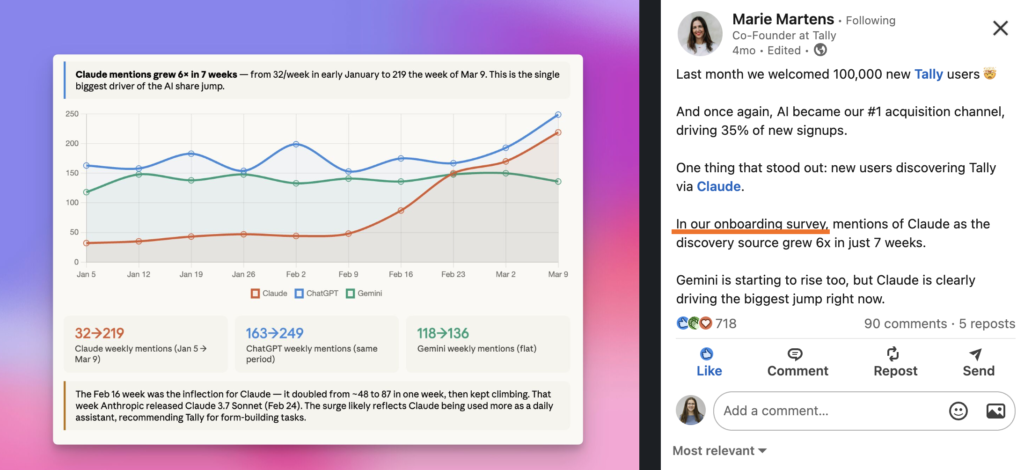
The obvious objection is that it relies on memory. How do you know someone actually remembers? You don’t. But we have no better tool for this channel, so even a shaky memory beats every proxy. Attribution here is broken the same way it’s broken for a billboard or a podcast ad. Asking directly is the closest thing to ground truth.
It also catches what analytics can’t. Sometimes you barely see any ChatGPT traffic, and then sales tells you a customer mentioned they found you through ChatGPT, or an investor says they came from Claude. That signal lives in conversations, not dashboards. The only way to capture it is to ask.
If you do one thing after reading this, add a self-attribution question to your signup or onboarding flow. It’s cheap, it compounds over time, and it’s the metric I’d trust first when reporting on AI search. Business leaders want to see the effect on real revenue before they keep investing in this direction.
AI search traffic: referral traffic and conversions from native AI engines
This is the hardest data you’ll get, and the most common form of attribution in marketing. Traffic from ChatGPT, Perplexity, Gemini, and Claude shows up as identifiable referral traffic, and you can attach the usual business metrics to it: leads, conversions, revenue. These reports are easy to build in GA4 or Looker Studio.
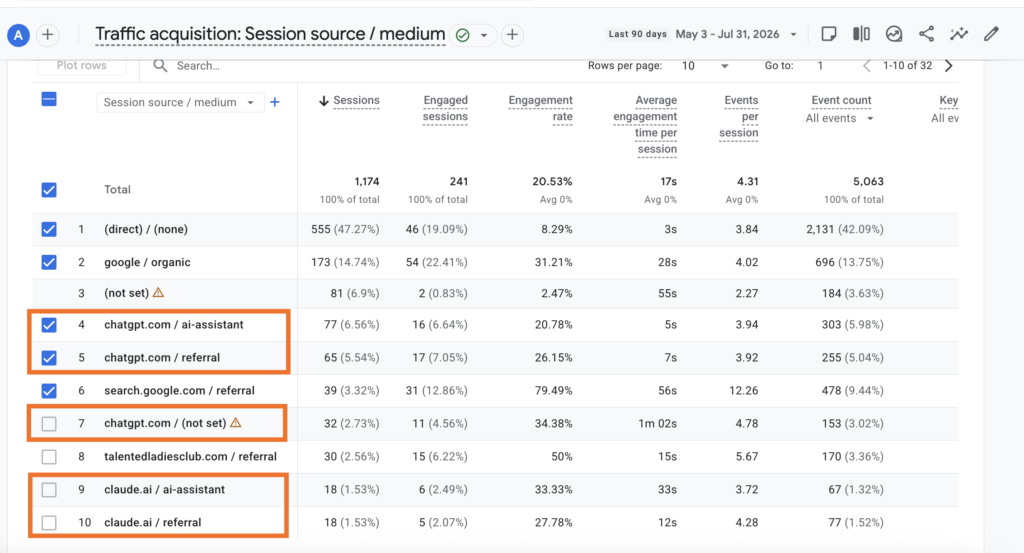
On the volume side, our own research at SE Ranking tracked 101,574 websites from January 2025 to April 2026. AI search engines sent 0.32% of all website traffic in 2026, up from 0.24% in 2025 and 0.02% in 2024. ChatGPT accounts for 74.78% of that AI traffic, Gemini 11.56%, Perplexity 7.23%, Copilot 3.51%, and Claude 2.62%.
There’s also a pattern many people in the industry report: AI referral conversion rate tends to be higher than regular organic. The volume is lower, but visitors arrive more aware and further along, so they convert better. In our own data, AI traffic is still a small slice of total visits, yet it brings a meaningful slice of leads and revenue.
Just remember this isn’t your total impact. Referral traffic undercounts your real influence, because so much AI exposure never produces a click. It produces awareness. People remember your brand and come back later, through branded search or straight to your homepage.
Brand presence in AI answers
For Google’s AI surfaces, where you can’t measure traffic, brand presence is the baseline proxy: are you mentioned at all in the AI Overview or AI Mode answer for the prompts you care about? It’s a yes or no signal across your target prompts, and everything else builds on it. If you’re not present, nothing downstream matters.
This applies to native engines too. Tracking whether ChatGPT or Perplexity mentions your brand for key prompts tells you if you’re in the consideration set, long before any click shows up in analytics.
Brand position in AI answers
Presence alone isn’t enough. Saying it is would be like calling position 10 good enough in SEO and never trying to climb.
Brand position means how high you appear inside the AI answer. The aim is to be the first recommendation for as many of your tracked prompts as possible. Being mentioned first is a much stronger sign that people actually saw you than being the fifth brand on the list.
Share of voice against competitors
This one follows directly from position. If you don’t own the first spot, which brand does, and how strong are they? Share of voice tells you where your brand stands against everyone else. Across your target prompts, how often do you show up compared with your competitors, and are you gaining or losing ground?
If there are strong leaders above you, study their approach. The goal is to close the gap and eventually beat them by getting recommended more often, in higher positions.
Citation coverage
When AI answers link out, being in the cited sources is a concrete signal that engines are pulling from your pages. It also shows you where to invest, since AI engines rely heavily on outside content: listicles, reviews, Reddit, YouTube, G2, and similar platforms, not just your own site. Tracking which of your pages and which off-site mentions get cited tells you what’s feeding the answers.
Usually you’ll find your own website there, and your job is to get more of it cited: blog posts, landing pages, help center, plus your social profiles and external sources that mention your brand. Ideally your citation coverage beats your competitors’, and you work on every property that affects AI search.
One caveat: AI answers are personalized and volatile
Before you lean too hard on any of these proxies, know that AI answers are heavily personalized and unstable. Ask the same question twice and you often get two different answers. Your neighbor, with different history and context, gets something different again. Regular rankings have this problem too, but it’s worse in AI.
So don’t expect a proxy metric like brand visibility to give you an accurate, absolute reading. It can’t. Look at the overall picture instead: your direction over time, the dynamics, and how you compare with competitors. A single check is noise. The trend and the gap against your rivals are the signal.
AI bot hits in server logs
This is the most technical option and the most raw. Watching your server logs for AI crawlers (GPTBot, PerplexityBot, and the rest) tells you which pages the engines are fetching. It’s an early, unfiltered signal of what’s being read, and it’s often the first thing teams reach for because it’s fully in their control.
Keep it in perspective, though. Bot hits measure crawling, not visibility or influence. A page being fetched doesn’t mean your brand is being recommended. Treat it as a diagnostic input, not a success metric.
Brand sentiment and incorrect information
Being mentioned isn’t automatically a win. You can show up in AI answers with negative sentiment, which is worse than not being mentioned at all, because now the model is steering people away from you at the exact moment they’re asking who to trust. So track sentiment alongside presence: not just whether you appear, but how you’re described. This is the part that feels closest to PR and brand work, and it’s where the SEO or AI search person should work with a PR person.
Inaccurate and outdated mentions are the other half. A model may describe you with old information: a price far below what you charge now, a positioning you moved past, a feature you dropped. That misleads potential customers and undercuts your own messaging. Monitor for it, and treat fixing stale or negative mentions as part of the job, the same way a PR team manages what’s said about the brand everywhere else.
Branded search and direct traffic growth (indirect signal)
Here’s a signal a lot of teams miss. When someone finds you in ChatGPT or sees your brand in an AI answer and doesn’t act right away, they often Google you next, or go straight to your homepage. Rising branded search and direct traffic can be a downstream effect of AI visibility.
If branded queries and homepage visits climb while AI visibility climbs, and you haven’t changed anything else (no new branded ad spend, for example), that’s a reasonable sign it’s working. It’s indirect and you have to control for other causes, so treat it as a corroborating metric rather than a headline one.
Track what matters, not everything
You can’t track every prompt, and you shouldn’t try. Query data is limited, more and more traffic comes from long-tail and very specific prompts, and full coverage isn’t realistic. Track the high-volume prompts and keywords that matter to the business, and assume that if you’re visible for those, you’re probably visible for the long-tail variations around them. That keeps measurement focused on what moves the business instead of drowning you in prompts you can’t influence anyway.
Break them into clusters as well, so you can track visibility per cluster and adjust your work accordingly.
Build a composite dashboard, and cross-check
No single metric here is trustworthy enough to stand alone. Together, they tell a coherent story. The setup I’d recommend combines three layers: self-reported attribution from your signup or onboarding flow, GA4 traffic and conversion data from native AI engines, and brand visibility proxies (presence, position, share of voice, citations) from whichever AI visibility tool you use. Add sentiment monitoring and branded or homepage traffic. Plan log file analysis on top.
Then cross-check. If self-attribution to AI engines is rising, referral conversions are up, and your visibility metrics are climbing, the numbers agree and you can report with some confidence. Revenue stays the headline; everything else supports it.
On tooling, it helps to know what each type is for. Some tools are built for tracking and monitoring: dashboards for presence, position, mentions, share of voice, and sources across Google and AI engines, with data you can pull into your own reports or via API. Others are built for workflows and automation, where the value is acting on the data rather than reporting it.
An optimal setup is a visibility tracker plus your own analytics (GA4) plus your self-attribution product data. Then you build automation on top of that.
Treat AI visibility as a mix of brand awareness and SEO
Your AI visibility campaign will probably look like a combination of SEO, social, and PR work. The attribution looks like social and PR too, where you often can’t tell how many people a channel influenced.
That’s the situation with AI visibility. You measure exposure and influence with proxies, corroborate with the cleaner signals you do have, and accept that the last mile of attribution stays fuzzy. That’s not a reason to skip measuring it. It’s a reason to measure it honestly, with a system built for approximation instead of a single number pretending to be precise.
Frequently asked questions
How do you measure AI search visibility?
You measure it with a set of KPIs, not one number. Start with conversions and revenue from self-reported attribution (ask customers where they found you), add traffic with revenue and conversions from native engines, then layer on proxies like brand presence, position, share of voice, and citations, plus branded search growth as an indirect signal. No single metric is complete, so you triangulate.
What are the best AI search visibility KPIs?
The ones I’d prioritize, in order: conversions and revenue from self-reported attribution, AI traffic from native AI engines with revenue and conversions, AI referral conversion rate, brand presence and position in AI answers, share of voice against competitors, citation and source presence, and branded search growth. AI bot hits in server logs are a useful diagnostic, not a success KPI.
Can you measure AI visibility revenue?
Partly. You can have the most accurate revenue number from self-reported attribution. Then, there’s traffic from native AI engines (ChatGPT, Perplexity, Gemini, Claude) with leads and revenue in GA4 or Data Studio, so that slice is directly measurable. Other AI visibility metrics are harder to connect with revenue.
What’s the best way to measure AI visibility?
Self-reported attribution is probably the best way to measure AI visibility: ask customers where they found you at signup, during onboarding, or on sales calls. It’s the industry standard and the most accurate signal available. It undercounts, because people skip the question and misremember, but it captures influence no dashboard can see.
Can you track traffic from Google AI Overviews or AI Mode?
Not directly. Google puts all Search traffic in one bucket, so you can’t separate regular organic from AI Mode or AI Overviews in Search Console. An older workaround using fragment URLs in Analytics let you isolate some of it, but Google has stopped supporting that. For Google’s AI surfaces, rely on presence, position, and share of voice instead of traffic.
How is measuring ChatGPT different from measuring AI Overviews?
Native engines like ChatGPT, Perplexity, Gemini, and Claude send direct referral traffic you can attribute like any other channel, conversions included. Google’s AI surfaces don’t give you that breakdown. So native engines are the measurable half, and Google’s AI features are the proxy-only half.
Are server logs a good way to measure AI visibility?
They’re useful but limited. AI bot hits in your server logs show which pages engines crawl, which makes a good early diagnostic. They don’t tell you whether your brand is actually recommended or seen, so treat them as an input, not a success metric.
Do I need a dedicated AI visibility tool?
A visibility tracker makes presence, position, share of voice, and citations much easier to monitor, and most let you pull the data into your own dashboard or via API. But no tool closes the attribution gap on its own. The strongest setup combines a visibility tracker, your own analytics for referral traffic, branded search trends, and self-reported attribution.
