

How to optimize for AI search? [Quick answer]
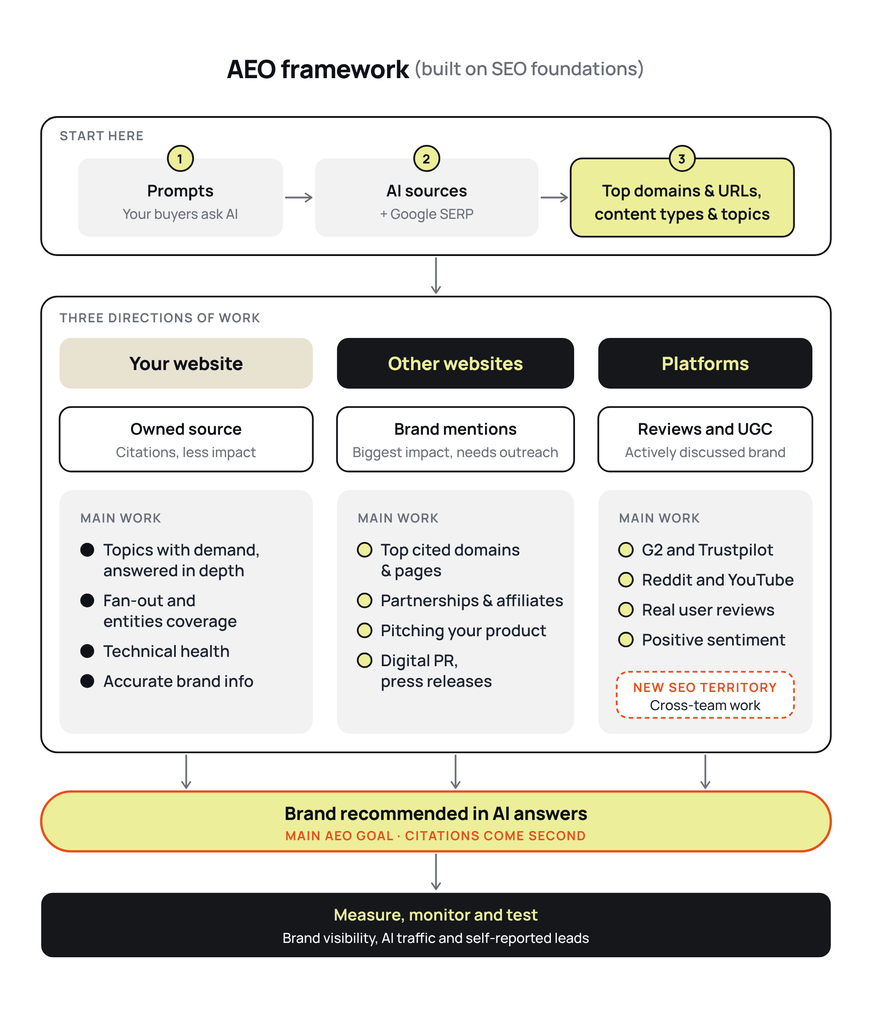
👉 To optimize for AI search (AEO), your two main goals are getting your brand recommended (the main one) and your resources cited (the secondary one) in AI answers for the topics (clusters of keywords and prompts) you care about.
👉 For most companies, AEO work comes down to three directions. The first two are especially important for being recommended and being able to compete: getting mentioned on the external websites LLMs already cite for those topics, and keeping your brand present and actively discussed on platforms like YouTube, Reddit, G2 and similar ones, with real reviews there. The third one is the core SEO part – working on your own website to create and optimize content around your focus topics and making sure your website is accessible to AI bots. It’s important for getting your website citations (and referral traffic), but it often has less impact.
👉To begin work on AI visibility, start by understanding your own and your competitors’ visibility. For that, you need to identify the right prompts to track. Then comes AI engine source analysis (which sites AI cites for your prompts) plus a SERP check for your core keywords, so the same work also grows your visibility in regular Google. Based on that, you build a plan for the websites you need to get mentioned on and the content you should create.
In 2026, optimizing for AI search and getting clients from it has only become more in demand, and AI search has become a legitimate new marketing channel. It grew out of SEO and became one of SEO’s areas of responsibility, but by its nature, it sits between organic search and brand/PR.
This year, a lot has happened, especially with ChatGPT model changes, but the core approach remains the same. If you closely follow LinkedIn, X and industry voices, you may feel FOMO, as if you can’t keep up with everything or can’t draw a clear framework for approaching AEO.
However, most of the growth I’ve seen came from a basic approach that requires consistency and openness to experimentation, not from complicated technical tweaks.
So, I hope this AEO guide will help you get a clear framework for approaching AI search, build a roadmap for 2027, and feel more confident about AI visibility as part of your SEO work.
In a nutshell (brief version of this AEO guide)
👉 AI search optimization builds on SEO but adds a different goal: getting your brand mentioned and recommended in AI answers, not only ranking your own pages and getting organic traffic to your website. Citations are also important, but they are secondary for AEO.
👉 AI search optimization work runs in three directions that each affect your visibility and are channels of their own: your website, other websites (blogs), and presence on the platforms that impact AI search (YouTube, Reddit, G2, etc.). Your website matters, and you do want to get citations and be the main owned source of information about your business for LLMs. However, getting mentions and reviews on external websites and platforms is even more important for getting recommended by AI – and it builds a stronger brand at the same time (which is also a foundation for AEO).
Your owned properties (your website and owned accounts)
👉 For your website, get the technical foundations right before anything else: make sure pages are accessible to AI bots and indexed by major search engines, and that your content is present in the HTML rather than loaded by JavaScript. Schema is mostly a Google topic, and llms.txt has no proven impact – but test it on your own site.
👉 Create and optimize content that works for Google and LLMs at once: create pages with real search demand that also cover your users’ questions and the fan-outs around it, with dense facts and entities, unique data, and regular updates (if it’s a blog post). This way, you can get traffic from Google and appear as a source in AI answers without sacrificing either goal. Don’t scale AI-written content without real value, search demand and effort behind it, as organic Google is still your focus channel, and you don’t want to risk your website’s visibility.
👉 Make sure the information on your website and your company profiles is up to date and shows the right, consistent image of your brand everywhere. This includes your profiles on review platforms like G2, social media, GBP for local businesses, business listings, and other sources.
👉 YouTube has already become an important marketing and traffic channel on its own, but it also matters a lot for AI search, especially for AI Overviews. So consider having your own channel – it’s a great asset, and video production is getting cheaper and quicker with AI tools.
External websites and platforms you don’t own
👉 To grow brand visibility and recommendations, work on growing mentions on the external sites AI already cites for your topics, the way you’d build backlinks for Google. A link and a mention from a site that does well in both Google and ChatGPT is what’s worth getting. Proactively build partnerships with other websites and brands, offer your tool for testing, use your affiliate program if you have one – the main thing is to get more websites to mention your brand for the right topics and in the right context.
👉 Have accounts and support growth on the platforms that impact AI search: make sure you have profiles on G2, Trustpilot, GBP (for local businesses) and other relevant platforms. Motivate users to leave reviews there. Check which platforms LLMs favor for your topics (based on AI engine source analysis), but don’t drop one just because LLMs stopped citing it if it still brings you users (like Reddit).
👉 Generally, make sure the Internet talks about your brand and talks about it positively. This is part of building your brand, and probably the key part of building stable AI visibility.
The process
👉 Start your AEO work by choosing the prompts your buyers ask, split into non-branded (where the growth is) and branded (how AI describes you and if information is accurate). If you don’t have a recognized brand yet, focus on the first group and skip the second; if you already have a known brand, invest in the second direction as well (together with your PR team).
👉 Then check which sources AI cites for those prompts, plus the Google SERP for your core keywords. Source analysis is to AI search what the SERP is to Google, so combine both to build a healthy AEO + SEO strategy.
👉 AEO has a known attribution challenge, so agree with business management on how you’ll measure success – it’s not as easy as with traditional organic traffic and the conversions or revenue it brings.
👉 Finally, experimentation and monitoring changes should be part of your AEO work – ChatGPT updates models, sources change, Google changes the AIO layout, and the industry keeps coming up with new hacks. Keep some space for testing ideas.
How AI search optimization (AEO) differs from SEO
Let’s begin with the main question: how do SEO and AEO differ?
SEO and AEO share the same foundation – creating content that answers search intent, building brand authority around your main topics, and having the technical foundation set up right. However, they have different main concepts and different work priorities.
| SEO | AEO | |
|---|---|---|
| Main goal | Your website ranks high, gets organic traffic, leads and revenue | Your brand gets mentioned and recommended in AI answers |
| Main focus | Your own website | External mentions of your brand |
| Main work | Content, technical health, backlinks, user behavior | Brand mentions, wider brand presence, reviews, a more recognized brand |
| Technical and content optimization | High impact (titles and H1s are still very impactful) | Less impact |
| Off-page | Backlinks to build domain authority | Brand mentions matter more than backlinks |
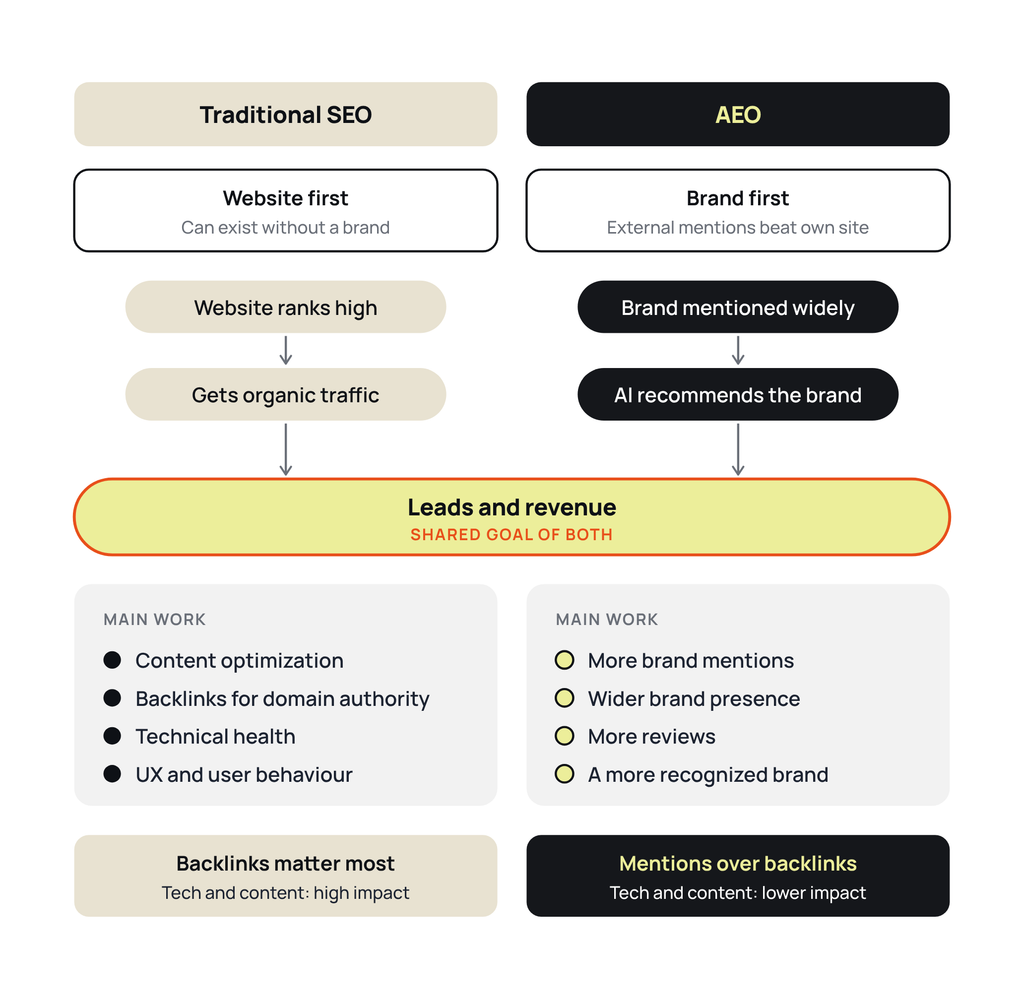
Main goals of SEO and AEO
In SEO, the main goal is the visibility of your own website (the website is the core concept and area of responsibility), while growing a brand is generally a non-SEO task: you grow rankings, traffic and leads from your website. With AI search, the main goal is for your brand to be mentioned and recommended in the answer, where brand visibility is the main asset and your website is one of the tools.
From a traditional (old) SEO perspective, the main AEO goal would be citations (which can bring traffic and leads), but for AEO, brand mentions (especially at the top of the answer) are the main win.
AEO vs SEO work
The work also differs. With both, you focus on covering the right topics with the right content and monitoring technical health – this is the common part. However, for AI search, your main focus is getting more brand mentions, and working with external properties is the more impactful direction. With SEO, you focus on your website first, while building backlinks to it to grow its domain authority (for AI search, you build brand authority).
With AEO, you should also care about platforms that impact AI search, like Reddit, YouTube, G2, Trustpilot and GBP for local businesses. Keep consistent, up-to-date information there and motivate new user reviews and discussions around your brand, while making sure your brand sentiment stays on the positive side.
Now, let’s move to the work itself in more detail. Use the sections below as a simple roadmap to build your AEO strategy – or better, to bring AEO into your SEO strategy.
Where to start: choose the right prompts to track
Your prompts define your work and your goals, so pick them wisely. You’ll have two groups of prompts to track:
- Non-branded (core for growth)
- Branded (monitoring your sentiment)
- Non-branded prompts
I recommend starting with non-branded prompts and building the list from core topics around your brand (e.g. your features, your products), with the main decision attributes (affordable, for [your audience], etc.) as well as your competitors (best alternatives to [your competitor]). These can be your top target keywords for SEO. This gives you the core commercial prompts you should care about and where you can see growth.
I also recommend splitting them into clusters the same way I would in SEO: one cluster per product or feature, use case or topic that matters to the business, so you can see your brand’s visibility and citations for each cluster separately (e.g. where you have gaps).
You can start from your business metrics (pages that bring you the most revenue or leads, or have that potential), work out which keywords can bring such people, build a list of top keywords (especially ones with some search volume), and then turn them into prompts. GSC data helps here. Customer calls are also useful for understanding recurring topics (e.g. the features customers are most interested in).
Branded prompts
Then there are branded prompts, which I’d recommend tracking if you already have at least some brand awareness – otherwise, people probably don’t search or ask about your brand (they can, if you appear for the non-branded commercial queries above). These prompts are mostly for tracking your sentiment and what content appears in the citations. Look for outdated product names, wrong company details or missing context, then follow the cited sources to find where that information comes from and fix it there (on your own pages, or by asking the publisher to update theirs).
Next: Analyze the sources and the SERP
LLMs build their answers from sources if there’s search included. When ChatGPT or Google AI Mode answers a prompt like “best project management tool for agencies”, it searches the web, retrieves pages, and pulls the brands and facts from them. If your brand isn’t mentioned on those pages, it’s very hard to end up in the answer.
That’s why source analysis is the starting point for AI search, the same way the SERP is the starting point for Google.
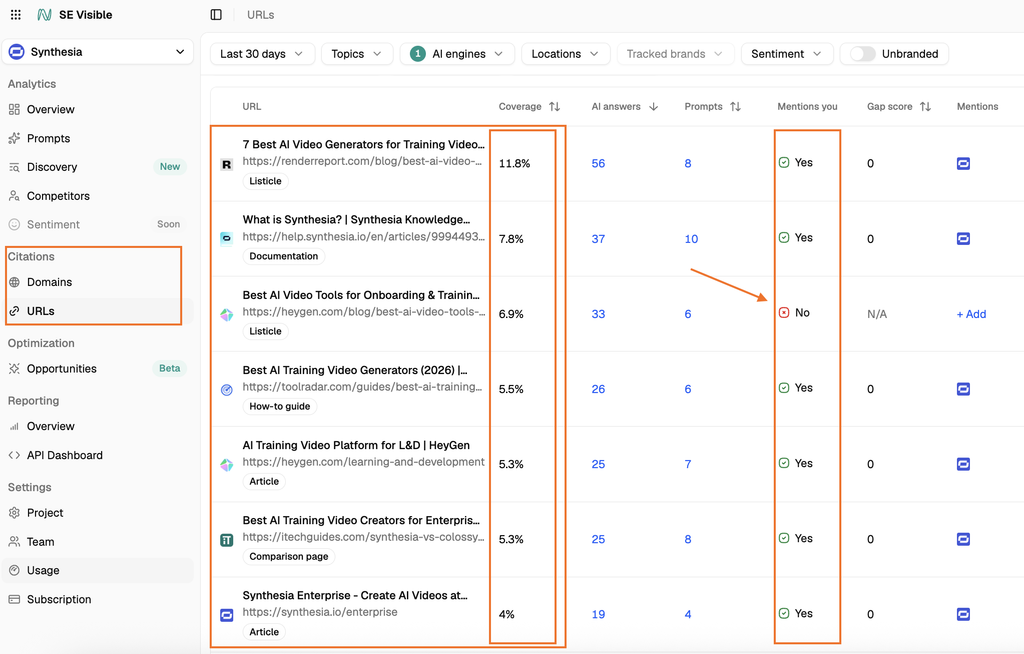
Here’s what I look at:
- The prompts that matter for your business – the questions your buyers ask AI before they buy (category questions, “best X for Y”, comparisons, alternatives).
- The domains and pages AI cites for those prompts – which sites show up again and again, and which competitors they mention.
- The query fan-outs – the background searches the model runs instead of your prompt as-is. They show which subtopics and modifiers the model thinks are part of the answer (I wrote a separate guide on how to find ChatGPT query fan-outs).
- The Google SERP for your core keywords – what ranks, what format wins, and where the demand is.
In my experience, the last point is often skipped, and I think that’s a mistake. Analyzing both the top sources and the SERP lets you plan work that grows your presence in AI search and, ideally, brings traffic and leads from traditional Google too. A page that only exists for AI citations and has no search demand behind it is a much weaker investment.
Also, keep in mind that some answers come from training data rather than real-time sources. In that case, it’s much harder to influence brand recommendations. Still, the more visible your brand gets across the web, the better your chances of showing up after training data updates.
AEO part 1: Work with your own website (on-page SEO foundations)
Working on your own website usually has less impact on AI visibility overall, but it’s still one of the main AEO pillars and a channel you own and can easily influence. Your website is the asset you control. It should be the main, fullest and most up-to-date source of information about your business for LLMs, and it’s still the place where people looking for your products or services convert into leads.
With your website, you have two main directions to include in your plan – technical health and content. The content part is what can bring you growth, while the technical side is what makes sure the content is visible.
Briefly, it means:
- Creating new content for your website and optimizing what you already have (e.g. content that ranks in Google but isn’t cited in ChatGPT, or important pages that appear nowhere).
- Checking technical health: crawlability, indexability, site structure, etc.
1.1. Content for AEO is still a central part of your SEO
Users and business owners still need content, and the right content is still central to SEO and AEO work. Every page on your site should have a purpose: business performance (converting visitors from organic search into leads, e.g. listicles or BoFU how-tos), educating customers and feeding LLMs your product information (feature pages, product how-tos and help center docs, which ChatGPT especially likes), or building trust and interest around your brand (unique data and studies).
A general rule for content planning is to find topics with demand in both channels, so one page works for both Google and LLMs. For Google, you know there’s demand because you can see the keyword volume. For LLMs, you collect the specific questions and intents around that topic (from your customers, query fan-outs, People Also Ask, Reddit, etc.) and cover them on the same page. And don’t create TOFU content where AI can easily answer the question, unless you can add specific value or tie it to your product.
The plan itself comes after a content audit that combines data from Google, AI search, business metrics and customers: your top earners, pages with big potential that don’t perform, non-performers, and content gaps with competitors in both Google and AI sources. I describe the full process step by step in my guide to running a content audit for SEO and AI search.
How to optimize content for AI search
To create or optimize content for AEO, keep the SEO content foundations and add AI search specifics on top:
- Search intent – the page should answer what the person (or the model) is actually looking for, based on the SERP, AI sources, and your customer data.
- Structure – specific headings with answers that work on their own, the answer near the top of each section, and lists and tables where relevant.
- Fact and entity density – numbers, sources, examples, and named entities instead of vague references, so LLMs have something they can lift as a fact.
- Unique data – original research, your own tests and first-hand experience. Google calls this non-commodity content and says it will likely influence your presence in its AI features.
- Fan-out coverage – if ChatGPT keeps adding “pricing”, “for small teams” or the current year to its searches, your page should cover those angles.
- Freshness – regular, real updates for blog content.
As for content chunking, AI retrieval systems often see only one passage of your page, so try to write sections that work on their own (and name the subject again instead of writing “as mentioned above”). There’s no need to engineer a whole chunking system, though, and Google says there’s no need to “chunk” your content for its AI features.
Finally, use AI for analysis, briefs, research and drafting, but don’t publish AI content without human verification and added value, and don’t scale content just because it’s easy. Publishing dozens of pages with little effort behind them can stop your website from growing or even lead to Google penalties. Each piece should have its purpose, search demand, and relevance for your business.
1.2. Technical SEO foundation
Technical optimization for AI search is mostly regular technical SEO: making sure crawlers can reach and read your important pages. It rarely brings growth on its own, in Google or in AI search, but it’s the foundation that lets your content work. These are the technical checks I’d start with:
- Indexing – your important pages are indexable and indexed in both Google and Bing, as ChatGPT still uses both on top of its own index.
- AI crawler access – your robots.txt, CDN and firewall settings don’t block AI search crawlers such as OAI-SearchBot, PerplexityBot or ClaudeBot. AI companies run separate bots for training and search (see OpenAI and Anthropic), so blocking a training bot like GPTBot doesn’t remove you from ChatGPT search.
- Content and links in the HTML – major AI crawlers don’t render JavaScript (Vercel’s crawl-log study with MERJ), so keep your main content and internal links in the server-rendered HTML.
- Schema – keep it for Google rich results, but don’t count on it for AI search: a study of ChatGPT citations by SE Ranking found pages with FAQ schema averaged 3.6 citations, compared with 4.2 for pages without it.
AI-specific extras like llms.txt get a lot of attention, but SE Ranking’s data shows llms.txt doesn’t help with AI search, and AI bots didn’t request it in my tests. A plain HTML AI information page linked from your footer (like tally.so/ai-info) is a better experiment. If you have developer docs, serving Markdown versions helps coding agents. Finally, check your 404 reports regularly for hallucinated URLs – links to pages on your site that LLMs make up.
AEO part 2: Work with other websites to get brand mentions
For AI search, being mentioned and recommended on the right external sites usually brings the most impact. It’s also the hardest and most time-consuming task, where consistency and patience matter most.
Your task here is to understand what content is already cited in AI search for your topics and try to get into it (these are usually listicles like “X best tools for…” if you track commercial prompts). Another task is to get mentioned in new content around your topics that LLMs can use for citations as well as training data.
Getting mentions for AI search is similar to getting backlinks for SEO: if you get a lot of relevant backlinks from high-performing relevant websites, you get a boost in Google. Same with mentions: the more relevant mentions you get on websites that LLMs use for answers, the higher your chances of being recommended by LLMs for your top queries and staying there.
So this should be your focus area if you want to grow in AI search, and you should be proactive about building relationships with other influential websites in your niche.
Build relationships with the current top cited sources
Your AI source analysis gives you a list of domains and pages that AI already cites for your prompts in a chosen AI engine. Those are the websites to reach out to first. If a page is cited for “best CRM for startups” and has the biggest citation share, and your brand isn’t on it, getting added to that page is the most direct way into the answer.
This works best as relationship building rather than one-off requests: offer data, a product demo, an expert quote, or an update that makes their page better. Be honest about what you offer, and don’t pay for inauthentic mentions.
Give sites that do well in AI search a reason to mention you
The most desired outcome is still getting mentioned as a tool recommendation, so focus on building reasons to get mentioned, which is not an easy task. You still need a good product by default and ideally a known brand, which makes this task much easier. And as a marketer, you need to build relationships with influential websites in your industry, so that when they create new content around your topics, they can mention your brand.
In practice, you’ll combine AI source analysis with the websites that perform well in Google too (AIO is a top AI system, and ChatGPT still uses Google’s index), which is the best long-term strategy for both SEO and AEO. With this domain list, build relationships with those sites and work on content collaborations so they mention your brand in their content.
Backlinks still matter
Don’t forget that backlinks still matter a lot for SEO, and SE Ranking’s research shows they’re also a top factor for LLMs. The SE Ranking study found referring domains were the strongest factor linked to ChatGPT citations: sites with more than 32,000 referring domains averaged 5.6 citations, compared with 2.9 just below that mark.
I explain it like this: by getting backlinks, you grow your strength in Google and become more visible and stable there (which is your goal in SEO), and you increase your presence in AIO, as AIO and the regular SERP overlap heavily. Also, by being visible in Google, you get used more by LLMs for grounding and training, and more websites mention you because you’re more visible. This is a reinforcing loop that benefits your business in the long run.
The ideal is to get both a link and a mention from a highly relevant website that does well in both LLMs and Google – it supports your rankings and your chances of being cited at the same time.
So keep aiming to get relevant backlinks from relevant, well-performing websites in your niche. Build partnerships, offer data and publish studies to strengthen your domain authority, which is core to a stable organic presence.
AEO part 3: Keep your brand visible on the review and UGC platforms that matter
While working on your website and building mentions (backlinks) are close to traditional SEO tasks, building presence on review and UGC platforms is something SEOs now need to borrow from other teams to impact AI search.
It’s about growing your AI visibility by being present on platforms where your audience discusses your topics and which LLMs also use for their answers. These are review platforms like G2 or Trustpilot, UGC spaces like Reddit, and social media like LinkedIn.
There’s also YouTube, which has a big impact on AI search and is also a good marketing channel on its own.
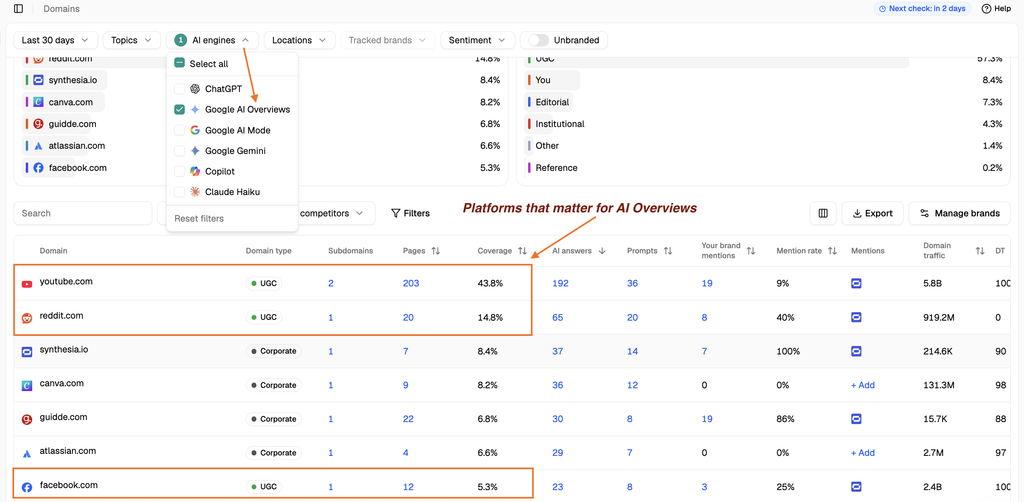
Platform dominance in LLMs keeps changing – as happened recently with Reddit in ChatGPT – so keep monitoring your sources and the news.
The main point is to be actively discussed on all the big platforms where users can mention you or your competitors. Being present there brings value to your business anyway and also increases your chances of being picked by LLMs as a top solution.
With UGC and review platforms, it’s also important to get specific reviews so you’re recommended for specific features or benefits. Overall, you also need positive sentiment, as you don’t want ChatGPT to mention you as a risky choice.
So here are the main rules:
- Check which platforms LLMs favor for your topics. Your source analysis will show whether AI cites Reddit, YouTube, G2 or something more niche in your category. Put more effort where the citations are.
- Don’t drop a platform just because LLMs don’t cite it. Citation patterns change quickly. If a platform still brings you users and brand reach, keep going.
For this direction, SEOs should actively build cooperation with other teams, as this is usually someone else’s channel in a bigger company. If you work alone, use AI source analysis as your main source of prioritization.
How to measure AEO results
AEO has a known attribution problem, so agree with business management on how you’ll measure success before the work starts. In my setups, I use three metrics: leads and revenue from self-reported attribution (a “How did you hear about us?” question at signup or on a sales call), traffic and conversions from AI engines in GA4, and brand visibility in the top 3 of AI answers for the prompt clusters you track.
Each direction of work also has its own signal. Mentions on external sites show up in brand presence and share of voice against competitors, work on your website shows up in citations of your pages and AI referral traffic, and work on review and UGC platforms shows up in how AI describes your brand (sentiment and accuracy). Growth in branded search and direct traffic can back all of this up when nothing else changed at the same time.
I covered this in my guide on how to measure AI search visibility.
Finally: track what changes
AI search changes regularly, so the work doesn’t end once you’ve optimized a few pages.
Watch your visibility and sources shift
Check how your visibility and the cited sources change over time, read the actual answers for your prompts (not only the visibility score), and see how query fan-outs change.
Google and AI engines often change their approach and the content they show, so regularly analyse AI engines’ sources and how their coverage changes, and be flexible and ready to adjust yours.
Monitor the industry and test new approaches
New ideas appear all the time, and some of them work. If you spot something that makes sense for your business, test it on a few pages or prompts, measure it, and only then roll it out.
If you need some GEO experiment ideas, Otterly AI has a nice hub with what they’ve tested.
Frequently asked questions
What is AI search optimization?
AI search optimization is the practice of getting your brand mentioned, cited and recommended in AI-generated answers from tools like ChatGPT, Google AI Overviews and AI Mode, Perplexity and Gemini. It’s also called AEO (answer engine optimization) or GEO (generative engine optimization). In practice, it builds on SEO and adds work on external mentions and platform presence.
Is AI search optimization different from SEO?
AI search optimization builds on SEO but has a different main goal. SEO is about your own website’s rankings and clicks, while AI search optimization is about getting your brand mentioned and recommended in AI answers, which also means building presence on platforms like YouTube and Reddit and earning mentions, not only backlinks. Google treats optimizing for its AI features as SEO, so the technical and content foundation stays the same.
What is the difference between AEO and GEO?
AEO and GEO are two names for the same work: improving how often and how well your brand appears in AI answers. Some people use AEO for answer-style results (featured snippets, AI Overviews) and GEO for generative chat tools, but in day-to-day work the tactics are the same.
How do you optimize content for AI search?
Optimizing content for AI search starts with covering the main question and the sub-questions around it on one well-structured page. Put the answer near the top of each section, keep the content in the HTML, add facts and supported claims, and cover the subtopics you see in query fan-outs. Then keep the page up to date, because AI tools often prefer fresh content.
How do you appear in AI search results?
Appearing in AI search results depends mostly on being mentioned on the sources AI already uses. Run a source analysis for your prompts, work on getting your brand onto the top cited pages, keep your own main pages clear and current, and stay active on the platforms LLMs cite for your topics. Technical tweaks alone rarely get a brand recommended.
How do you measure AI search visibility?
AI search visibility is measured with a mix of metrics, since no single number covers it. The usual set is brand mentions and citations across your tracked prompts, share of voice against competitors, the sources being cited, and business signals like branded search growth, self-reported attribution and conversions. Google Search Console also has a Generative AI performance report for Google’s own AI features.
What is changing in AI search optimization in 2026?
AI search optimization in 2026 is mostly changing in where models get their sources. ChatGPT’s search behavior shifted after the GPT-5.6 update, with changes in how many sources it uses and which types of pages it cites, and Google published official guidance for its AI features in 2026. So re-check your cited sources every few weeks rather than relying on last quarter’s picture.
